The line sits halfway down page 14 of the inspection report: “Gray plastic water supply piping observed. May be polybutylene. Recommend evaluation by a licensed plumber.” If you’re buying or selling a home built between the late 1970s and the mid-1990s, polybutylene pipes are one of the findings that can slow a sale down, and it helps to know what you’re actually looking at before anyone starts negotiating.
Polybutylene, often shortened to PB or poly, was a flexible plastic water pipe that builders liked because it was cheap to make and quick to run through walls. According to a 1994 report from the University of Arizona Water Resources Research Center, it was introduced in the late 1970s and by then had been used to plumb roughly six million homes across the US. The same report described the problem that ended its run: the pipes “often sprout leaks.”
Where to Look for It
You don't need to open a wall to get a good idea. Poly is usually visible in a few places:
At the water heater. Look at the pipes coming off the top of the tank. Poly often connects here, sometimes through a short metal adapter.
Under sinks and behind toilets. The pipe that comes out of the wall to the shutoff valves may be poly. In some homes, a short stub of copper comes through the wall and the poly is hidden just behind it, so this check can come up clean even when the house is plumbed with poly.
Where the main line enters the house. Follow the supply pipe back toward the street side of the property or the garage wall. A blue or black plastic line coming in from the street can be the service line made of the same material.
In the attic. In homes where the supply lines run overhead, you may be able to see them from the attic hatch with a flashlight. Don't walk across ceiling joists you're unsure of.
Telling Poly Apart From Modern Plastic Pipe
Gray plastic isn't proof on its own, because the plastics that replaced it can look similar at a glance. A few clues help:
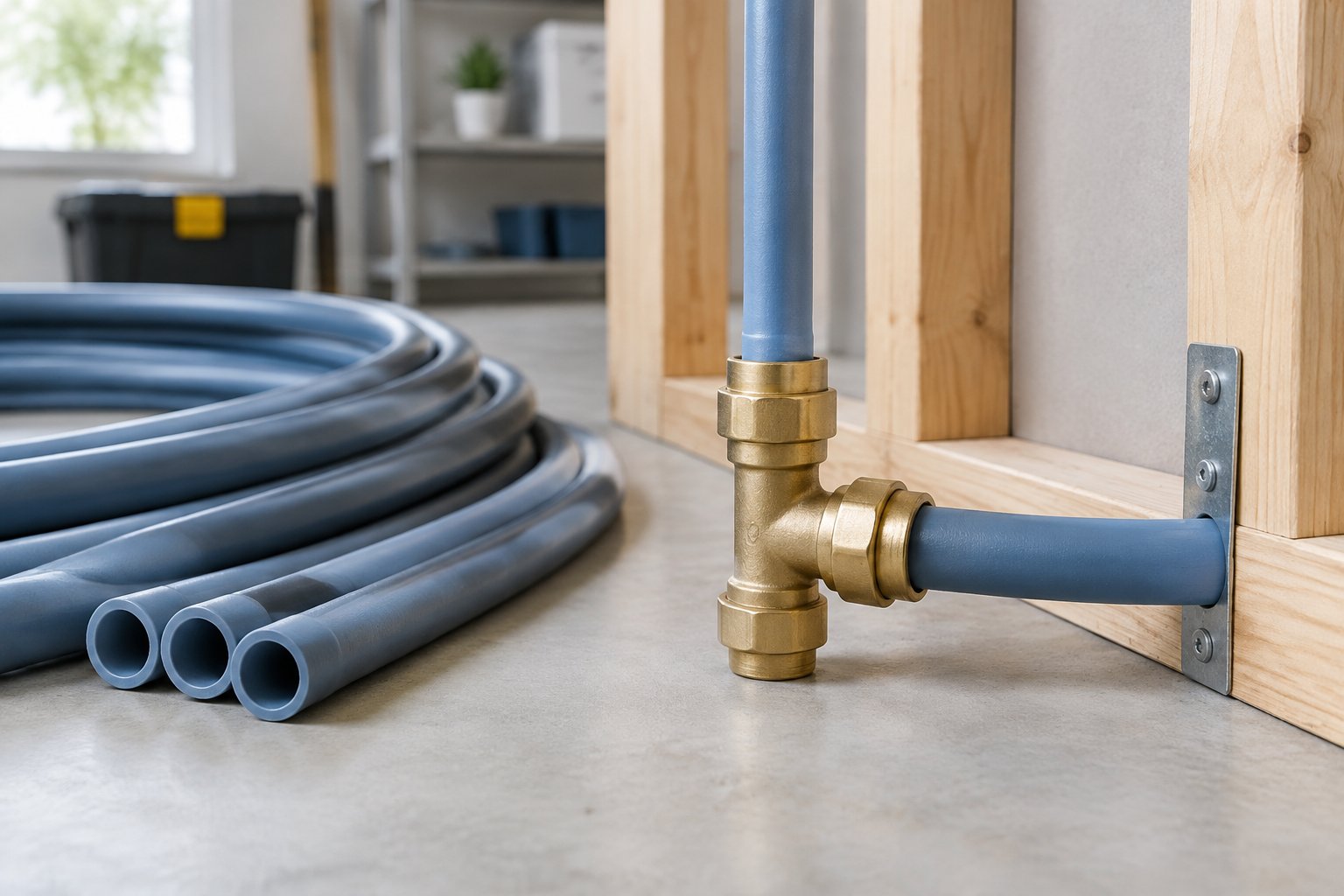
- Polybutylene is usually dull gray, sometimes white, with blue or black used for underground service lines. It is flexible and often stamped with the code PB2110 along its length. Fittings are either gray or white plastic, or metal crimp rings in copper or aluminum.
- PEX comes in red, blue, white and sometimes gray, and is printed with the letters PEX. It is the most common replacement for poly and is not the same material.
- CPVC is rigid rather than flexible, usually cream or light yellow, and joined with glued fittings.
The printing along the pipe settles most cases. When the letters have worn off, a licensed plumber can usually tell from the fittings and the age of the house.
Why Polybutylene Pipes Fail
The trouble starts on the inside. Public water systems disinfect drinking water, and over years of contact, those disinfectants are widely understood to weaken polybutylene and the plastic fittings used with it. The material becomes brittle and can develop tiny cracks on the inner wall. Nothing shows on the outside until the pipe or fitting finally gives way.
The University of Arizona report shows how early this was under debate. Manufacturers blamed most leaks on improper installation, and one contractor quoted put about 90 percent of all leaks at joints in the piping. A researcher who had tested the joints in a lab said some forms of oxidants, including chlorine, "cause exfoliation that weakens the structure." Whatever the mix of causes in a given house, the practical result is the same: the weak points are the fittings and the pipe wall, and both get worse with time.
That is why poly failures tend to be sudden. A fitting that held for 30 years can split without warning, and since the street pressure never lets up, water keeps coming until someone closes a valve. A failure in an attic or inside a wall can do a lot of damage before anyone notices.
Several things add stress to aging poly:
Hot water. Lines feeding the water heater and hot taps age faster than cold lines.
High water pressure. The Las Vegas Valley Water District puts the top of its normal operating range at about 100 psi and warns that pressure held above 80 psi can harm on-site plumbing. Aging poly is the last pipe you want carrying that kind of load.
Heat in the attic. Supply lines that run through a Las Vegas attic spend the summer in extreme heat, which doesn't help any plastic.
What Poly Means for Insurance and a Home Sale
Because of its history, polybutylene is something home inspectors are trained to flag, and some insurers ask about it when writing or renewing a policy. Rules vary from one insurer to the next, so if you own a home with poly, or you're about to buy one, it's worth calling your agent and asking directly rather than assuming.
For buyers, a poly finding usually becomes part of the negotiation, and a plumber's evaluation gives both sides something concrete to work with. For sellers, having that evaluation in hand before listing tends to make the conversation easier than learning about it from the buyer's inspector.
Living With Poly in the Meantime
Plenty of poly systems are still in service decades later, and a home with it isn't an emergency by default. Whole-house polybutylene pipe replacement is a large project, so many owners plan it on their own timeline. In the meantime, a few steps reduce the risk:
Know where your main shutoff is and make sure it turns. If a fitting fails, that valve is what stops the water.
Check exposed fittings every few months, especially the ones on top of the water heater and in the sink cabinets. Discoloration, white or gray flaking, or dampness around a crimp ring is worth having looked at.
Check your water pressure. A gauge threaded onto an outdoor faucet takes a minute to read. If it's high, a licensed plumber can check or adjust the pressure reducing valve, which takes strain off every pipe in the house. The regulator is described in our article about household water pressure.
Don't ignore small leaks. A drip at one poly fitting often means others of the same age are close behind. Our guide to preventing pipe leaks covers more habits that help.
Help With Leaks in a Poly System
If you've found a leaking section or suspect water is escaping somewhere you can't see, Dr. Cool can help. Plumbing repair covers leaking pipe sections and failed fittings, and water leak detection traces hidden water without guesswork. Book online or call (702) 873-1800. A burst fitting at 2 a.m. is exactly what our 24/7 emergency line is for.
Connect With Us
Our Contact Information
Reach Us by Phone or Email
If you prefer to speak directly with one of our technicians, don’t hesitate to contact us by phone or email. We’re available to assist you during business hours
Phone: (702) 873-1800
Email: info@drcoolservices.com
Business Hours:
Mon – Fri: 7:00 am – 9:00 pm
Sat – Sun: 8:00 am – 5:00 pm