
Before you pull the toilet or buy a wax ring, grab a towel, a few squares of dry toilet paper and a bottle of food coloring. A toilet leaking at base level is the end of a trail, and the water pooled on the floor is often not coming from where it appears. Ten minutes of detective work tells you whether the problem is a seal under the toilet or something dripping down from above, and those are very different repairs.
Dry Everything, Then Watch
Wipe the floor, the base of the bowl, the tank and every connection until they're completely dry. Then flush once and watch closely. Run a square of dry toilet paper along each spot listed below. Paper shows a damp patch long before you'd see a drop.
The supply line and shutoff valve. Check the valve on the wall, both ends of the flexible line, and where the line connects under the tank. A slow drip here runs down the line and lands right at the base.
The tank bolts. Two or three bolts hold the tank to the bowl, with rubber washers inside the tank. When those washers age, water seeps out along the bolts and down the back of the bowl.
The tank-to-bowl gasket. This large rubber seal sits between the tank and the bowl. A leak here only shows up during a flush, when water rushes through it.
The outside of the tank. If the whole tank feels damp and beaded with water, it may be condensation. In the dry Las Vegas air that's less common than in humid climates, but it can happen after a long hot shower in a closed bathroom. Condensation shows up across the whole cold surface, not at one spot.
For a second check, tint the tank water with food coloring and leave it alone for a while without flushing. Colored water appearing anywhere outside the toilet means a tank leak. Colored water appearing only after you flush, at the base, points under the toilet.
If your paper stays dry everywhere above the floor and water around the base of the toilet still collects after flushing, the leak is coming from below.
The Real Base Leaks
There are four common causes, and you can often tell them apart by how the toilet behaves.
A toilet that rocks
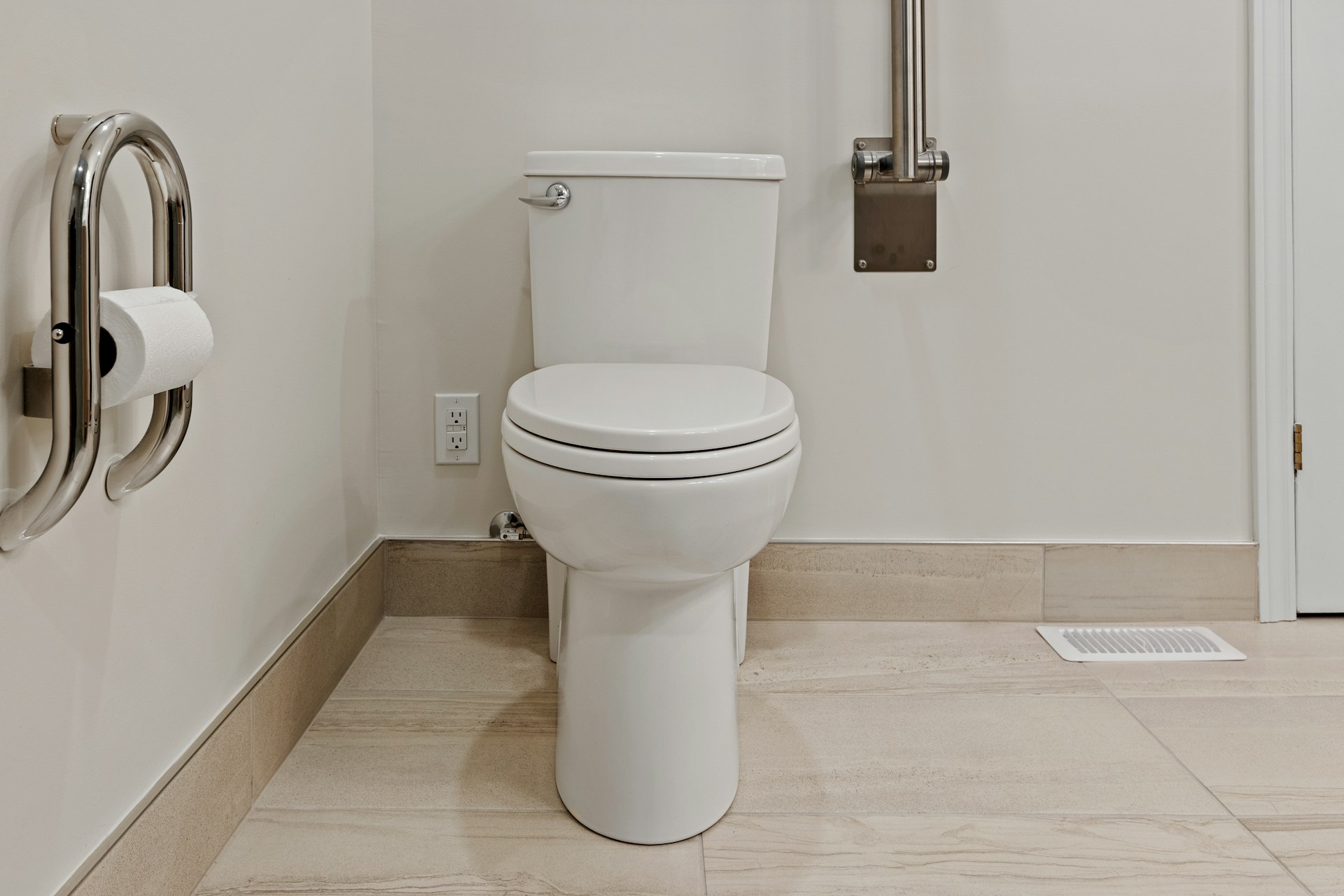
Sit on the closed lid and shift your weight gently. Any movement means the toilet isn't sitting firmly on the floor. That motion is the most common way the seal underneath gets broken, because each wobble squeezes and pulls at it.
Loose closet bolts
Two bolts, usually under plastic caps at the base, hold the toilet to the flange in the floor. If they've worked loose, tightening them a little can stop a wobble. Turn each one a quarter turn at a time, alternating sides, and stop as soon as the toilet feels firm. Porcelain cracks under too much force, and a cracked bowl is a much bigger problem than a loose one.
If the toilet still rocks after the bolts are snug, the floor may not be level or the flange may be broken. Plastic shims made for toilets can fill small gaps.
A failed wax ring
The wax ring seals the gap between the bottom of the toilet and the drain opening in the floor. It's designed to be compressed once. If the toilet has rocked, been lifted, or was set without enough pressure, the ring loses its seal, and each flush pushes some water out under the porcelain.
Signs point to the wax ring when water shows up only after flushing, when the floor around the toilet stays damp even though the tank and supply line are dry, or when you notice a sewer smell near the base. That smell matters, because the same gap that lets water out lets sewer gas in.
A cracked flange or bowl
The flange is the fitting in the floor that the toilet bolts onto. If it's cracked or corroded, the bolts can't hold the toilet tight and a new wax ring won't seal for long. A hairline crack in the bowl itself is rarer, but it can weep water at the base, and the only real fix for that is a new toilet.
What Toilet Wax Ring Replacement Involves
Replacing a wax ring is a common repair, but it's heavier and messier than it looks. The water has to be shut off and the tank and bowl drained. The supply line is disconnected, the bolts removed, and the toilet lifted straight up. A two-piece toilet is awkward to carry, and lifting it at an angle can spill the water left in the trap.
Then the old wax gets scraped off both the toilet horn and the flange, and this is the moment to inspect the flange closely. A broken flange, rotted subfloor or a flange sitting below the finished floor level all need sorting before a new ring goes on. The toilet goes back down in one straight, firm press, the bolts are tightened evenly, and the water is turned back on and tested.
Some people use a wax-free seal made of foam or rubber instead of wax. Both work when installed correctly. Whichever you choose, it has to suit the height of your flange relative to the floor.
If the flange needs repair, you aren't comfortable lifting a heavy fixture, or the floor feels soft, this is the point where a plumber earns the visit.
Why a Small Base Leak Shouldn't Wait
A toilet that leaks a little with every flush adds up. On a second floor, the water soaks into the wood subfloor and can stain the ceiling below. Ground-floor bathrooms in the Valley usually sit on a concrete slab, so they don't have a wood subfloor to rot, but water still travels under vinyl and laminate, into tile grout and up into baseboards and drywall. Mold can take hold in any of those spots well before a stain gives it away.
The sewer gas that escapes through a failed seal is the other reason not to wait. It's unpleasant at best, and a bathroom that smells even after cleaning is a sign the seal is gone.
If you've found water near a toilet but can't trace it to the toilet itself, a hidden supply line or drain leak under the floor may be responsible. Our water leak detection service finds water you can't see without tearing up the floor.
A Few Related Problems Worth Knowing
If you'd like to put names to the parts mentioned above, our toilet parts guide labels each one. A toilet that gurgles or bubbles while a sink or tub drains points to a venting or drain issue rather than a seal, which we cover in toilet bubbling and gurgling.
Getting a Dry Floor Back
Dry it, trace it, then fix what you find. If the leak turns out to be the wax ring, the flange or something under the floor, Dr. Cool can reset the toilet and check what's underneath. Book plumbing repair online or call (702) 873-1800. If water is reaching the room below, ask to be seen the same day.
Connect With Us
Our Contact Information
Reach Us by Phone or Email
If you prefer to speak directly with one of our technicians, don’t hesitate to contact us by phone or email. We’re available to assist you during business hours
Phone: (702) 873-1800
Email: info@drcoolservices.com
Business Hours:
Mon – Fri: 7:00 am – 9:00 pm
Sat – Sun: 8:00 am – 5:00 pm