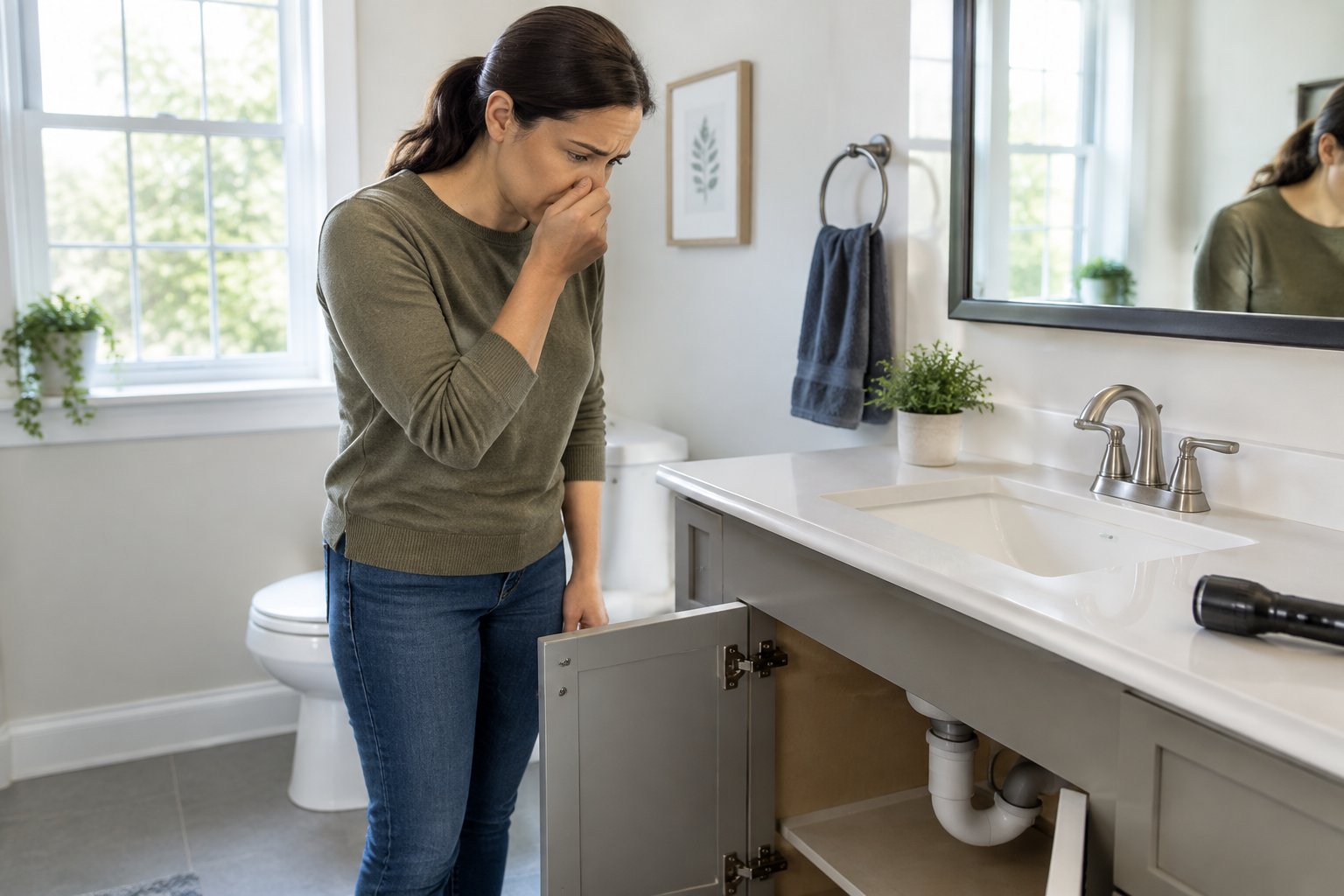
You open the door to the guest bathroom for the first time in months and get hit with the smell of a public restroom on a hot day. Or it’s subtler than that: a faint, sour whiff in the hallway that comes and goes, strongest in the evening, gone by the time anyone else walks over to check. A sewage smell in house air is unpleasant, but it is also useful, because where it’s strongest tells you most of what you need to know about where it’s coming from.
Work through the rooms below in the order the smell leads you. Many of the causes take seconds to fix. A few need a camera in the line.
Make Sure It's Sewer Gas and Not Natural Gas
Before anything else, be sure of what you're smelling. Natural gas utilities add an odorant that smells like rotten eggs, and so does hydrogen sulfide, one of the gases in sewer air. If the smell is near your furnace, water heater, stove or gas meter, or you hear a hiss, don't hunt for drains. Leave the house, then call Southwest Gas or 911 from outside.
If the smell is clearly coming from drains or a bathroom, it's sewer gas. It's still worth taking seriously. According to OSHA, low concentrations of hydrogen sulfide irritate the eyes, nose, throat and respiratory system, and people can lose the ability to smell it even while it is still present. In other words, a smell that "goes away" after you've been in the room a while may not have gone anywhere. Open windows, run the bathroom fan and start looking.
Strongest in a Room Nobody Uses
This is the most common cause, and the easiest fix in this article.
Every drain in your home has a trap, a bend in the pipe that holds a few inches of water. That water is the only thing sealing the sewer side of your plumbing off from your living space. Our explainer on what a P-trap is shows how it works.
When a fixture goes unused, that water evaporates, and in the dry air of a Las Vegas summer it goes faster than most people expect. Once the trap runs dry, there's an open path from the sewer into the room. Guest bathrooms, a second shower nobody uses, a laundry sink, and the floor drain in a laundry room or garage are the usual suspects.
The fix: run water in every drain in that room for about a minute, then flush the toilet. If the smell fades within an hour, you found it. Make a habit of running unused fixtures every week or two. For floor drains that sit dry for months, a tablespoon of mineral oil poured in after the water forms a thin film that slows evaporation. If a floor drain is also sluggish, our guide to unclogging floor drains covers that next step.
Strongest Right Around the Toilet
A toilet sits on a wax ring that seals it to the drain pipe in the floor. When that ring fails, sewer gas escapes at the base, and the smell is sharpest when you're standing next to the bowl or after a flush.
Check a few things by hand:
- Does the toilet rock? Even slight movement can break the wax seal. The bolts at the base may need snugging, but over-tightening can crack the porcelain, and a ring that has already broken needs replacing rather than squeezing.
- Is there staining or dampness at the base? Water seeping out where gas is escaping points to the same failed seal.
- Is the caulk around the base intact? Caulk doesn't seal sewer gas on its own, but cracked caulk lets you see into the gap.
Replacing a wax ring means pulling the toilet, which a handy homeowner can do. If the flange underneath is cracked or the floor around it is soft, that's a job for a plumber.
Toilets that bubble or gurgle while another fixture drains are a different signal, which our post on why a toilet bubbles explains in detail.
Strongest at the Sink
A sink can smell sewer-like for reasons that have nothing to do with the sewer. The overflow channel, that little hole near the top of a bathroom sink, collects soap, toothpaste and hair, and the gunk inside turns sour. So does residue clinging to the pop-up stopper assembly. Pull the stopper, clean it, and scrub the overflow with a small bottle brush and hot soapy water. If the smell disappears, the drain was dirty rather than leaking gas.
If the sewage smell only appears when you run hot water, and cold water smells fine, the source is probably your water heater, not your drains.
Under the sink, look at the trap itself. A loose slip nut or a crack in a plastic trap lets gas out, and you'll often see moisture there too.
Gurgling Drains Mean Air Is Taking the Wrong Route
Your drain system needs air to work. Vent pipes run up through the roof and let air into the lines, so draining water doesn't create suction. When a vent is blocked, water pulls air from wherever it can find it, which often means sucking it through the water in a nearby trap. The result is gurgling drains, slow draining and a trap that gets siphoned partly empty, which lets sewer gas in.
A few clues point to venting:
- a sink gurgles when the tub drains nearby
- a sewer gas smell shows up right after a big drain, like a washing machine emptying
- the toilet water level drops or rises on its own
Some newer homes have air admittance valves, small one-way valves under a sink or in a wall instead of a full roof vent. When one sticks open, it lets gas out instead of only letting air in.
Roof vents can be blocked by debris, nests or wind-blown trash. Climbing onto a roof in Las Vegas heat is risky, and the shingles and tiles here can be slippery or brittle, so leave the roof check to a professional.
Strongest Outside or Everywhere at Once
When the smell is faint throughout the house, strongest near the lowest drains, or noticeable outside near the foundation, look further down the line.
Start with the sewer cleanout, a capped pipe sticking out of the ground near the house or a few feet into the yard. If that cap is cracked, missing or knocked loose by a mower, sewer gas vents right beside your home. A replacement cap is an easy fix.
If the cleanout is intact, the problem may be inside the system itself: a cracked drain pipe in a wall or under the slab, a separated joint, or a main sewer line that is partly blocked or damaged. Signs that it's the main line include several drains slowing at once, gurgling from more than one fixture, and water backing up into the lowest shower or tub. Those cases need sewer line repair rather than another round of cleaning traps.
Finding a Hidden Source Without Opening Walls
When the easy checks come up empty, guessing gets expensive. Two tools let a plumber find the source without tearing into drywall or concrete.
A sewer camera is a waterproof camera on a flexible cable fed through the cleanout or a drain. It shows cracks, separated joints, sags where waste collects, and blockages, all in real time. A sewer camera inspection also records the depth and location of any problem, so if a repair is needed, it can be done in one spot instead of along the whole line.
Smoke testing is the other method. Harmless, visible smoke is pushed into the drain system, and wherever it seeps out, from a cracked pipe, a bad seal or a vent connection, there's your leak.
Clearing the Air for Good
Plenty of sewer smells end with a bucket of water in a forgotten drain or a new toilet seal. The ones that linger are worth a closer look, because the same crack letting gas in can also be letting waste out.
If you can't find the source, Dr. Cool can run a camera through your line and show you exactly what's happening. Book online or call (702) 873-1800, and if sewage is backing up into the house, emergency service is available 24/7.
Connect With Us
Our Contact Information
Reach Us by Phone or Email
If you prefer to speak directly with one of our technicians, don’t hesitate to contact us by phone or email. We’re available to assist you during business hours
Phone: (702) 873-1800
Email: info@drcoolservices.com
Business Hours:
Mon – Fri: 7:00 am – 9:00 pm
Sat – Sun: 8:00 am – 5:00 pm