
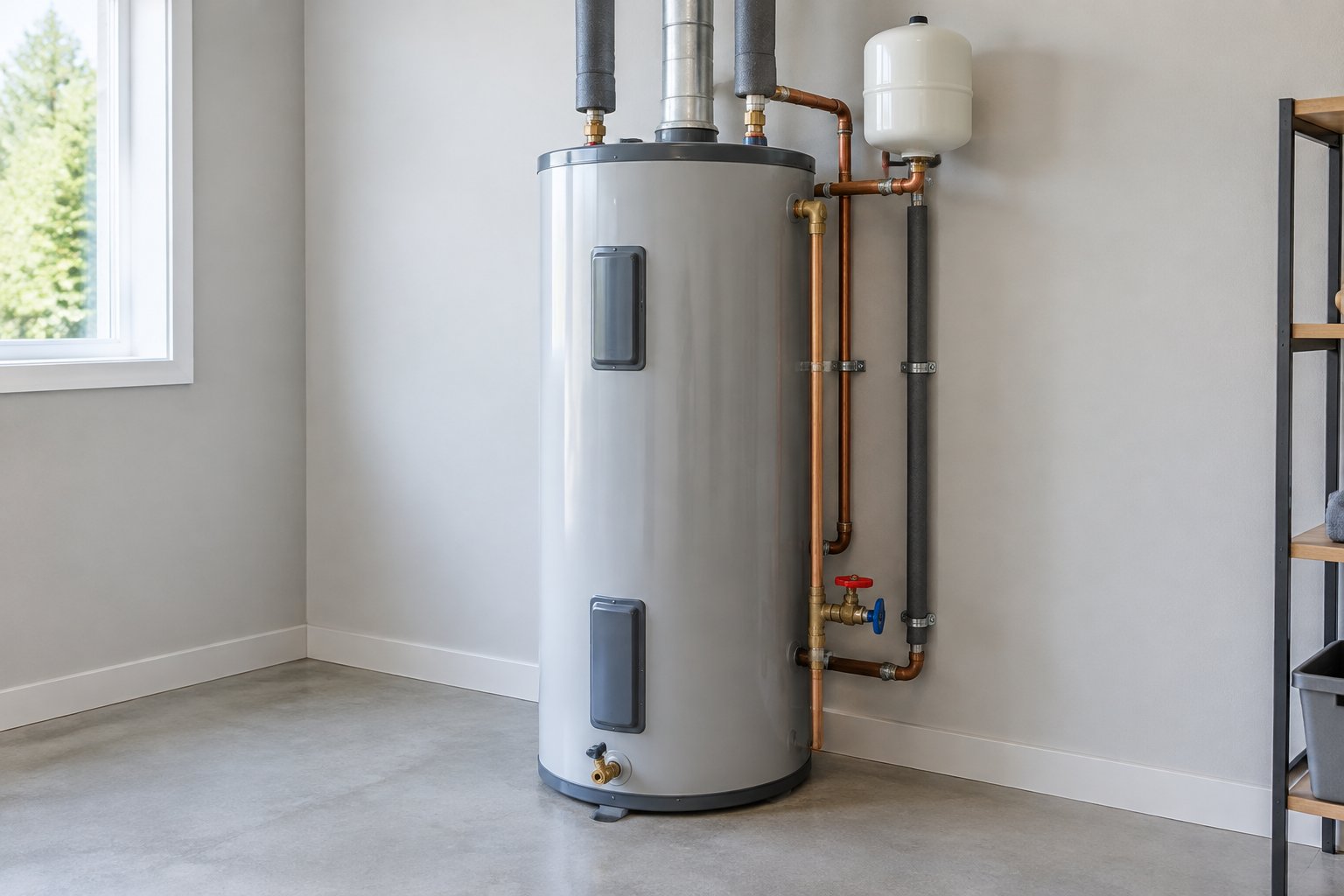
Somewhere on the side of your water heater is a sticker that knows exactly how old it is. Most people never look at it until a repair estimate lands and they’re trying to decide whether to fix the thing or start over. Search “how long do water heaters last” and you’ll get a national average. Your own answer starts with that sticker, followed by an honest look at what Las Vegas water does to a tank year after year.
The National Numbers
The U.S. Department of Energy puts the typical life of a conventional storage tank at 10 to 15 years, and a tankless heater at about 20 years. Its Energy Saver guide says tankless units can last more than 20.
Those are ranges, not promises. Two identical heaters installed on the same day can finish years apart depending on the water running through them, how hard they work and whether anyone looks after them. In the Las Vegas Valley, the water is the biggest of those factors.
Finding Your Heater's Age
The rating plate on the tank lists the model and serial number. Some labels print the manufacture date outright. Many more hide it in the serial number, usually as a letter or pair of digits for the month and two digits for the year, often near the start. The exact format varies from one manufacturer to the next, and the manufacturer's website or customer line can decode it if the pattern isn't obvious.
A few other clues help if the label is faded:
- the date written on a permit sticker or inspection tag nearby
- the date on the home inspection report from when you bought the house
- your own memory of whether the heater was there when you moved in
The manufacture date and the install date can be a year or so apart, since heaters can sit in a warehouse before they're fitted, but either one gives you a working age. Write the year somewhere you'll find it again, such as on a piece of tape on the tank. It saves this exercise next time.
Why Las Vegas Water Shortens the Clock
Water here is very hard by the Las Vegas Valley Water District's own measure, with roughly 17 grains of hardness in every gallon (close to 290 ppm). That hardness is mostly dissolved calcium and magnesium, and heating water makes those minerals drop out of solution. Inside a tank, they pile up on the bottom as sediment.
That layer causes two problems over the years. On a gas heater, it sits between the burner flame and the water, forcing the tank floor to run hotter every time the burner fires. On an electric heater, it can bury the lower element. Both shorten the life of the parts they touch.
Hard water also wears out the anode rod, the sacrificial metal rod that corrodes so the steel tank doesn't. When it's used up, the tank lining takes the damage instead, and rust through the tank wall is the one failure that can't be repaired.
Tankless heaters don't collect sediment the same way, but hard water leaves scale on the inside of their heat exchanger. Left alone, it restricts flow, causes overheating shutdowns and wears the unit out early. Descaling on a regular schedule is how tankless units in hard-water areas reach the long end of their range.
None of this means a heater here can't reach 15 years. It means the ones that do are usually the ones somebody has maintained.
Habits That Add Years
Flush the tank. Draining sediment before it hardens keeps the bottom of the tank cooler and the elements clear. The Energy Saver guide recommends a quarterly quart drain, and in hard-water homes a yearly full flush is worth adding.
Check the anode rod. Hard water uses up anodes faster than the manufacturer may have assumed. Having it inspected every few years, and replaced when it's worn, protects the tank itself. Our guide to the anode rod explains what's involved.
Soften the water. A water softener removes much of the hardness before it reaches the heater, cutting down on sediment and scale throughout the house.
Keep the temperature sensible. A tank kept hotter than it needs to be works harder and drops minerals out faster. The Energy Saver guide recommends 120°F, which suits most households.
Keep pressure in check. High water pressure in the home stresses the tank, valves and fittings every time the heater runs. A plumber can test it and recommend a fix if it's running high.
Water Heater Repair or Replace: A Rule of Thumb
When something breaks, the age of the heater and the type of failure together usually make the decision clear.
The tank itself is leaking. Replace, at any age. A rusted-through tank can't be patched.
The heater is in the first half of its expected life. Repair almost anything else. Elements, thermostats, thermocouples, gas controls, valves and dip tubes are all designed to be replaceable, and a young heater has plenty of service left.
The heater is past the first half of its life. Small repairs still make sense, especially a single failed part on a tank that's otherwise in good shape. For a bigger repair, a common rule is to weigh the repair against what a new heater would involve. If the repair is a large share of what replacement would take and the tank is getting near the end of its range, replacement is usually the better use of money.
The heater is at or past the typical range. Even a minor repair deserves a second thought. A 14-year-old tank in hard water may have a repairable thermostat today and a corroded tank next year. Replacing on your own schedule is far easier than replacing after a leak.
A technician's view of the tank's condition matters as much as the age on the label. A well-maintained 12-year-old heater can be in better shape than a neglected 7-year-old one. Dr. Cool's water heater repair visits use upfront pricing, so you see the repair price before deciding.
Planning Ahead Beats Replacing in a Hurry
If your heater is in the last few years of its range, a little planning helps. Decide in advance whether you'd replace like for like or consider a different type, and check that the space, venting and gas or electrical supply would suit what you'd choose. Our guide to choosing the right water heater walks through the options.
Replacing a heater before it fails also means no emergency, no flooded garage and no cold showers while you compare options. Dr. Cool offers financing plans for homeowners who'd rather spread out the cost.
Getting a Straight Answer on Your Heater
The label tells you the age, and the water tells you how hard those years have been. If you're weighing a repair against a new heater, Dr. Cool can inspect yours and walk you through both options. For new water heater installation of tank or tankless models, book online or call (702) 873-1800.
Connect With Us
Our Contact Information
Reach Us by Phone or Email
If you prefer to speak directly with one of our technicians, don’t hesitate to contact us by phone or email. We’re available to assist you during business hours
Phone: (702) 873-1800
Email: info@drcoolservices.com
Business Hours:
Mon – Fri: 7:00 am – 9:00 pm
Sat – Sun: 8:00 am – 5:00 pm